 Brand

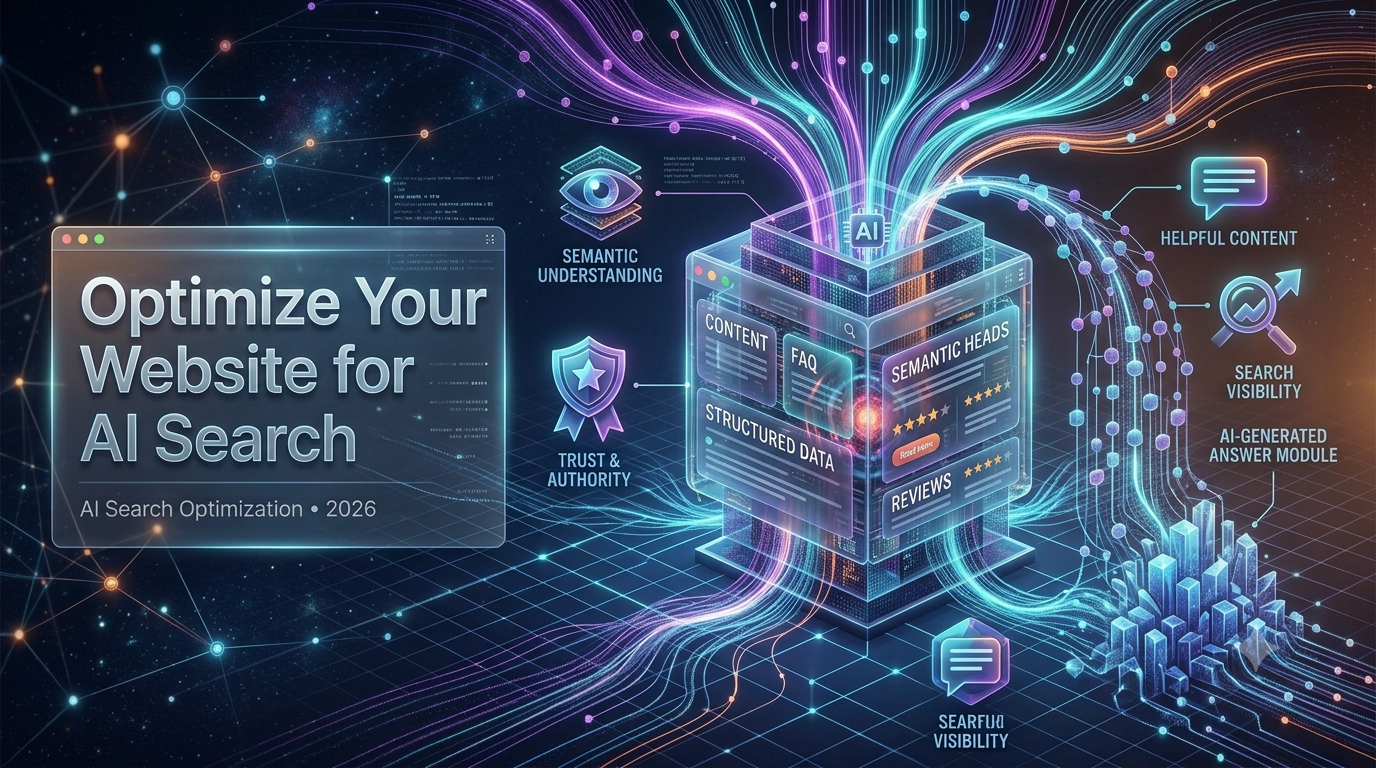
How to Optimize Your Website for AI Search in 2026:
Generative Engine Optimization (GEO) refers to optimization practices that make a website’s content, structure, authority and technical accessibility conducive to discovery, understanding, retrieval, and citation verbatim or via summarization by AI search systems.
Traditional SEO focuses on SERPs: search engine results pages. A page’s rank on SERPs, along with the number of impressions, clicks, and traffic drives the SEO success of a page. GEO adds another goal: becoming a reliable source of information within AI search results.
Why it matters in 2026: search results are evolving beyond SERPs. Google now has AI Overviews, Microsoft’s Bing and Copilot offer AI answers, and ChatGPT Search can retrieve and cite relevant websites..
What Is GEO. How Is It Different From SEO?
The simplest way to understand the difference is:
SEO asks: "How can my webpage rank for this search query?”
GEO asks: "How can my content become a source that an AI system uses when answering this question?”
For example suppose a digital marketing company publishes an article about Generative Engine Optimization. A traditional SEO strategy might target keywords such as:
- what's GEO?
- GEO vs SEO?
- generative engine optimization?
A GEO-oriented strategy would also organize the content so an AI system can easily identify the definition, differences, examples, statistics, recommendations and supporting evidence.
However GEO should not be treated as a replacement for SEO. Google explicitly states in its 2026 guidance that existing SEO fundamentals remain relevant because its generative search experiences are built on core Search systems.
In practice the best strategy is therefore SEO plus GEO than SEO versus GEO.
Why Did GEO Emerge?
The growth of GEO comes from a change in how people find information.
Previously a user might search Google scan ten results, open websites compare information and decide what to trust.
AI search systems increasingly perform part of that process for the user. They can interpret a question retrieve information from multiple sources summarize it compare alternatives and provide links to supporting websites.
Google describes techniques such as Retrieval-augmented generation (RAG) and "query fan-out " where AI search can explore related searches and sources before constructing a response.
Microsoft similarly describes grounding as a layer connecting AI systems with web information. Its Bing Webmaster Tools now reports when websites are cited in AI-generated answers.
This creates a visibility problem for businesses. A company might rank well in conventional search but still receive little visibility if AI systems choose other sources when constructing their answers.
GEO addresses this layer of discovery.

How GEO Works in Practice:
There is no accepted "GEO algorithm" or guaranteed formula for getting cited. Google, Microsoft and OpenAI use systems. Nevertheless several practical principles are emerging.
1. Create Original, Useful Content
AI systems have access to quantities of similar information. Simply rewriting what already exists is unlikely to create a competitive advantage.
Businesses should publish content containing:
Original research
First-hand experience
Expert opinions
Unique examples
Product comparisons
Case studies
statistics
Practical processes and frameworks
Googles 2026 guidance specifically emphasizes valuable unique non-commodity content rather than content created simply to manipulate generative results.
2. Make Important Information Easy to Extract
AI systems need to understand what a page says.
Use a structure:
H1 ? H2 ? H3 ? short paragraphs ? lists ? tables ? examples
For example instead of writing a 500-word paragraph explaining SEO and GEO provide a clear comparison:
| SEO | GEO |
|---|---|
| Focuses on search visibility | Focuses on AI-answer visibility |
| Rankings are important | Citations and references can matter |
| Targets search queries | Targets questions, topics and intents |
| Optimizes for search engines | Optimizes content for AI retrieval and interpretation |
This structure is easier for both humans and machines to understand.
Bings current guidance similarly recommends headings, concise sections, tables, FAQ-style information, evidence and regularly updated content.
3. Answer Questions Directly
AI search is conversational so content should address questions.
Of only targeting:
“Digital marketing”
also answer questions such as:
“What is digital marketing?”
“How does digital marketing work for businesses?”
“Which digital marketing channel is best for beginners?”
“How much does digital marketing cost?”
This creates a broader topical footprint and gives AI systems clearly defined passages that can potentially support answers.
4. Demonstrate Expertise and Trust
AI systems need information particularly for topics involving money, health, law, technology or business decisions.
1. Businesses should therefore:
2. Identify authors and their expertise.
3. Cite sources.
4. Link to research where possible.
5. Include publication and update dates.
6. Correct information.
7. Clearly distinguish facts from opinions.
8. Provide company information and contact details.
9. Maintain information across the website.
The objective isn't to "trick" an AI into mentioning a company. It is to make the website genuinely useful enough to deserve reference.
5. Strengthen Technical SEO
One of the important 2026 lessons is that technical SEO still matters enormously.
Google says pages need to be crawlable, indexable and eligible to appear in Search before they can be supporting links in AI Overviews or AI Mode.
Businesses should therefore check:
Robots.txt
XML sitemaps
links
Canonical URLs
Page speed
Mobile usability
JavaScript rendering
HTTPS
Indexing problems
Duplicate content
Structured data
Crawl accessibility
Bing likewise says that crawling, indexing, URL consolidation, content clarity and authority signals support both traditional search and AI experiences.
6. Use Structured Data
Structured data can help search systems understand entities such as:
Products
Organizations
Businesses
Articles
Events
Reviews
But businesses should avoid adding misleading or invisible information simply to influence AI systems.
Importantly Google says there is no GEO schema"or AI-only markup required for inclusion in AI Overviews or AI Mode.
So claims such as "add this GEO schema and your website will appear in ChatGPT" should be treated skeptically.
The Role of AI and LLMs
Large language models (LLMs) are central to the search experience but businesses should not assume that an LLM simply reads every website in its training data.
Modern AI search can combine language models with retrieval systems. A user asks a question the system identifies information retrieves sources and then generates an answer based partly on those sources.
This is why being discoverable and understandable is critical.
Businesses can also use AI internally for GEO work. For example an SEO team can use LLMs to:
- Generate customer questions.
- Identify content gaps.
- Categorize search intent.
- Analyze competitors.
- Rewrite sections.
- Create content outlines.
- Test whether important answers are easy to identify.
Ai-generated content should still receive human review. Bing warns against scale automatically generated content that lacks editorial oversight, usefulness, accuracy or originality.
Real-World Applications in 2026:
GEO is already becoming measurable than purely theoretical.
For example Bing Webmaster Tools has an AI Performance report showing which pages are cited in AI-generated answers across Microsoft Copilot, Bings AI-generated summaries and selected partner experiences. It also provides "grounding queries" associated with citations.
For a business this could mean ensuring its name, address, opening hours, services and other important information are accurate across its website and relevant business profiles.
For an e-commerce company, useful product descriptions, specifications, comparisons, images and availability information can help AI systems understand the products.
For a B2B company guides original research, implementation documentation, case studies and expert commentary can provide material that AI systems can use when answering research-oriented questions.
ChatGPT Search is another example. OpenAI currently states that public websites can appear in ChatGPT Search and recommends ensuring that OAI-SearchBot is not blocked if publishers want their content to be discoverable cited and linked.
GEO and Traditional Search Engines:
The relationship between GEO and search engines is therefore closer than it may initially appear.
Googles AI features still depend heavily on Googles Search infrastructure. Bings AI experiences similarly rely on crawling, indexing and ranking systems.
This means a business should not abandon SEO.
Instead think of the search journey as several layers:
Technical SEO ? Crawling ? Indexing ? Ranking/Retrieval ? AI interpretation ? Citation/answer ? Website visit ? Conversion
Optimizing the earlier stages supports the later ones.
Challenges and Open Questions:
GEO is still an evolving field and businesses should be careful about treating every GEO tactic as established fact.
First there is no GEO ranking factor list. Different AI systems use retrieval and generation methods.
Second citation does not necessarily equal traffic. Bing explicitly says its AI Performance citation metric does not represent clicks, traffic, authority or engagement.
Third AI answers can change. The same question may produce sources or wording at different times.
Fourth zero-click behavior is a concern. Users may receive information from an AI answer without visiting the original website. Recent reporting has highlighted concerns from publishers about declining traffic as AI-generated summaries become more prominent although Google disputes broad claims of an overall traffic decline.
Finally the industry is still developing measurement standards. "AI visibility," "citation share," "mentions," "referrals," and "brand presence" are not necessarily the thing.
Practical GEO Checklist, for 2026:
Businesses can start with a simple process:
1. Fix SEO first.
Make sure important pages can be crawled, indexed, rendered and discovered.
2. Build authority.
Create content that covers the important questions within your industry.
3. Prioritize information.
Add research, experience, examples, data, opinions and case studies of producing generic rewrites.
4. Structure content clearly.
Use headings, short sections, lists, tables, definitions, examples and direct answers.
5. Demonstrate expertise.
Use authors, sources, references, dates and transparent company information.
6. Keep information current.
Update prices, products, statistics, policies, services and other time-sensitive information.
7. Optimize beyond text.
Use images, video, product information and local-business information where relevant. Google specifically highlights these content types in its generative-search guidance.
8. Monitor AI visibility.
Use tools such as Bings AI Performance reporting, alongside Google Search Console, analytics, rankings, conversions and referral data.
9. Check AI answers manually.
Search important customer questions in AI search experiences and see which sources are being cited.
10. Don't chase "GEO hacks."


0 Comments
No comments yet. Be the first to share your thoughts!
Leave a Comment